
The catalogue
100+ checks, and what each discipline covers
Most of them are defects that cost you score; the rest are suggestions — worth doing, never a fault. Every one has a written guide, rendered inside the product beside the finding that raised it.
Structured Data & Rich Results
JSON-LD parsed and validated per type — Organization, Product, FAQ, Article, Breadcrumb and more.
Crawl Behaviour
robots.txt, sitemaps, redirect chains and loops, broken internal links, orphan pages.
Page SEO Basics
Titles, meta descriptions, canonicals, H1–H6 structure, duplicate elements, indexability.
HTTP Security Headers
HTTPS and certificates, HSTS, CSP, Referrer-Policy, X-Frame-Options, mixed content.
GEO & AI Engine Signals
Whether llms.txt and llms-full.txt are published, follow the format, and point at pages that resolve.
Image Analysis
Alt text, width and height attributes, modern formats, descriptive filenames.
International SEO
hreflang pairs, x-default, self-referencing tags, RTL direction, per-language URLs.
URL Parameter Audit
Whether parameterised and faceted URLs are canonicalised, and canonicals stay clean.
AEO Content Signals
Reading level scored for answer engines rather than only for people, and whether a comparison page carries a comparison table.
Semantic HTML
Whether key regions use real landmarks instead of bare divs, and figures carry captions.
Content & Readability
Placeholder copy left in the page — the lorem ipsum that shipped by accident.
100+ checks, across every discipline above
Every check has a guide
The fix, beside the problem
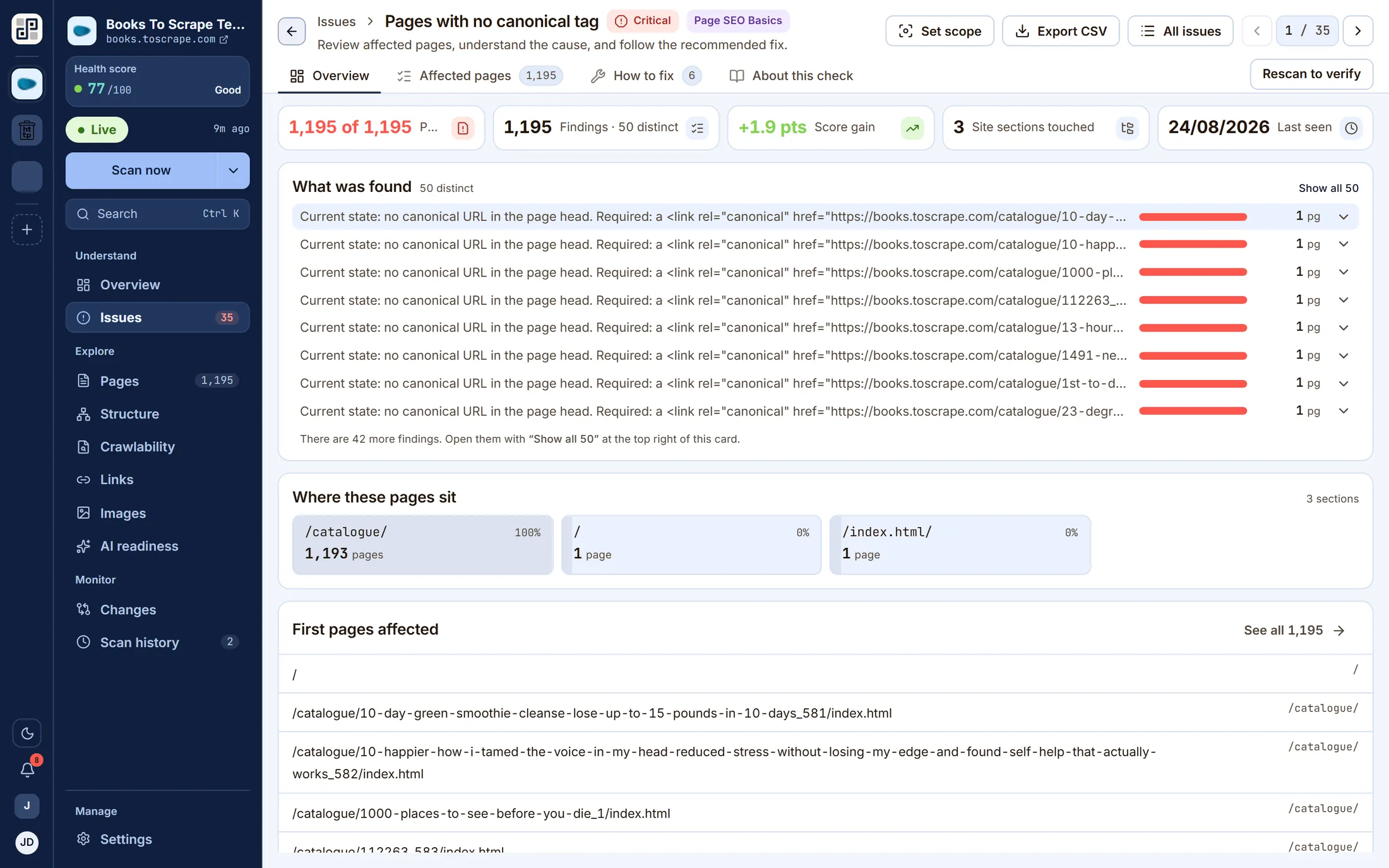
Open a finding and the guide for that check is on the same screen: what it is, why it matters, how to put it right, with examples. No tab switching and no searching a knowledge base for the check you were just looking at.
- Written per check, not per category — “missing canonical” and “canonical points elsewhere” are different problems with different fixes.
- The same content is what the product renders inline, so the guide and the finding can never disagree.
- Every guide names the affected URLs from your own crawl, not a generic example.
How severity works
Not every finding is worth the same
Severity is what the health score is weighted by. Scoring a missing canonical and a slightly short title identically is what made older versions of this kind of tool unusable — the list was long and the order meant nothing.
Stops a page being indexed, reached or served safely. A missing sitemap, a broken internal link, a page not on HTTPS.
Measurably costs you visibility or presentation. Missing Open Graph tags, absent schema, no security headers.
Worth fixing, rarely urgent. A missing content-language declaration, an unpublished llms-full.txt.
Advice, not a defect. Carries no severity and costs no points — a 47-character title is not a fault.
Run every one of them against your site
The free plan runs the entire catalogue over 500 URLs a month. That is a complete audit of most sites, and a real baseline for every one.
Free plan · 1 site · 500 URLs a month · all 100+ checks · no card